

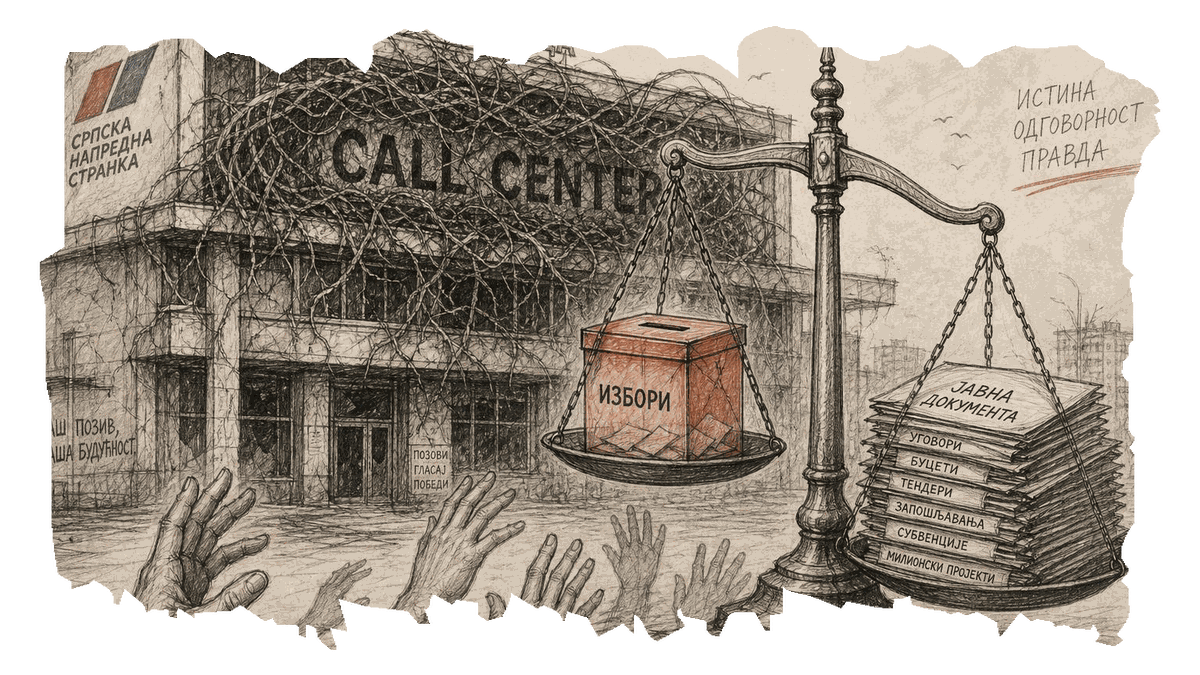
The Serbian Progressive Party (SNS) is facing allegations of using public resources for its political campaigning, following reports that a call center has been established within the administrative building of Lasta, a public transport company. This building, located on the highway to Niš, is majority-owned by Miroslav Nikolić, who is said to have provided two floors for the SNS call center ahead of the upcoming elections. Nikola Jovanović, director of the Center for Local Self-Government, has raised concerns about the legality of this arrangement, given Lasta’s public-private partnership with the city of Belgrade.
Jovanović claims that the use of Lasta’s facilities for political purposes is illegal, as the company receives substantial funding from the city budget and other local governments through public-private partnerships for city and suburban transport services. He questions whether it is appropriate for a company benefiting from public funds to support a political party in this manner. Jovanović further inquires about the involvement of SMC Data, another company associated with Nikolić, in this setup.

Nemanja Nenadić from Transparency Serbia explains that the legality of renting space for campaign activities hinges on whether the rental is conducted under market conditions. If the SNS pays the full market price, it is a legitimate campaign expense that must be reported in financial disclosures. However, if the space is provided free of charge or at a reduced rate, it could be considered an illegal contribution to the SNS campaign. This is particularly problematic if the contribution comes from a company engaged in a public-private partnership, as such entities are prohibited from making political contributions under Serbian law.
Lasta was privatized last year, with ASP Strela from Obrenovac acquiring about 85% of the company. Despite this, a portion of Lasta’s shares remains under state ownership through the Shareholders’ Fund, the Republic of Serbia, and the Pension and Disability Insurance Fund. The city of Belgrade sold its shares on the stock exchange. Lasta and its associated companies, owned by Miroslav Nikolić, have secured lucrative contracts with the city, including a ten-year agreement worth approximately 125.9 billion dinars (about 1.1 billion euros) for suburban and local transport lines.
These developments have sparked concerns about the misuse of public resources for political gain, a recurring issue in Serbian politics. The SNS, which has been financially dominant in the political landscape, has previously been accused of leveraging public funds to bolster its electoral campaigns. The allegations surrounding the Lasta call center add to the scrutiny of the party’s campaign financing practices.
The situation raises questions about the transparency and fairness of political financing in Serbia, particularly in the context of public-private partnerships. As the elections approach, these allegations could influence public perception and potentially impact the electoral process. Legal experts and political analysts may need to weigh in on the implications of such practices and their alignment with Serbian electoral laws. The lack of direct responses from Miroslav Nikolić or the SNS regarding these allegations further complicates the issue, leaving room for speculation and calls for greater accountability in political campaigning.




0 Comments