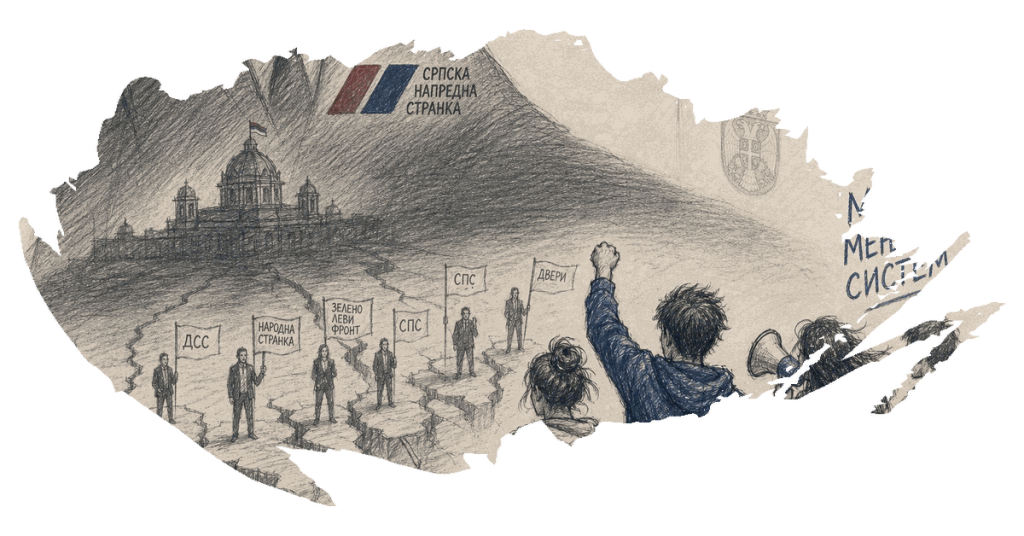
As Serbia approaches its extraordinary parliamentary elections on October 25, a debate has emerged regarding whether the country is experiencing a referendum-like atmosphere for or against the government. This sentiment has been fueled by the refusal of student organizations to collaborate with opposition parties, which some believe has undermined the opposition’s efforts to present a united front against the ruling Serbian Progressive Party (SNS).
Zdravko Ponoš, a leader of the ‘Evropska Srbija’ coalition, has publicly stated that the notion of a referendum atmosphere has “died at birth” due to the lack of student support for opposition parties. Ponoš’s comments were made during an appearance on television, where he addressed accusations that his coalition, along with the ‘Autentična desnica’ coalition, was disrupting a potential referendum atmosphere by choosing to run independently in the elections. Ponoš argued that the atmosphere dissipated when student organizations decided not to align with the opposition.

The ruling regime, led by President Aleksandar Vučić, appears concerned that the elections could turn into a de facto referendum on their governance. According to narratives circulated by pro-government media, there is no referendum atmosphere, suggesting that opposition groups, labeled as “blockaders-terrorists” by these outlets, are being manipulated by foreign entities against Vučić, who is portrayed as a defender of Serbia’s sovereignty.
The political landscape is further complicated by the presence of the ‘Studentska lista – Studenti pobeđuju’ (Student List – Students Win), which has gained significant traction. Public opinion research suggests that the election will be dominated by two main blocs: the student list and the list led by Vučić. The student movement has been a significant force in recent Serbian political activism, reflecting broader youth dissatisfaction with the current regime. This movement’s emergence has led to a shift in the dynamics of the opposition, with some parties choosing to support the student list instead of fielding their own candidates.
Analysts like Andrej Ševo, a researcher at the Institute for Philosophy and Social Theory, have noted that in a referendum-like atmosphere, smaller parties face increased difficulty in surpassing the electoral threshold. This perception could lead voters to believe that votes for smaller lists are wasted, thus discouraging support for them. Tamara Bajčić, executive director of Demostat, adds that the decision by the ‘Narodna Srbija’ coalition to support the student list further crystallizes the referendum-like atmosphere, potentially increasing voter turnout and diminishing the chances for smaller parties to meet the electoral threshold.
The stakes are high for opposition coalitions like ‘Evropska Srbija’ and ‘Autentična desnica’, as their failure to cross the three percent threshold could result in their votes being redistributed to Vučić’s ‘Ujedinjena Srbija’ (United Serbia) under the proportional representation system. Dragan Popović, director of the Center for Practical Politics, has observed that for the past two years, there has been a steady creation of a referendum atmosphere, driven by a segment of society organized against what they see as an undemocratic regime.
The discourse surrounding the elections is intense, with discussions focusing on whether coalitions like ‘Evropska Srbija’ and ‘Autentična desnica’ will be able to secure enough votes to enter parliament. Popović notes that the current political climate has led to a sense of urgency among voters, with many expressing sentiments like “now or never” and “the time has come,” which are indicative of a referendum atmosphere.
As the elections draw near, the political landscape in Serbia remains highly polarized, with significant implications for the future of the country’s governance. The role of student activism and the opposition’s ability to unite against the ruling party will be critical factors in determining the outcome of the elections.