

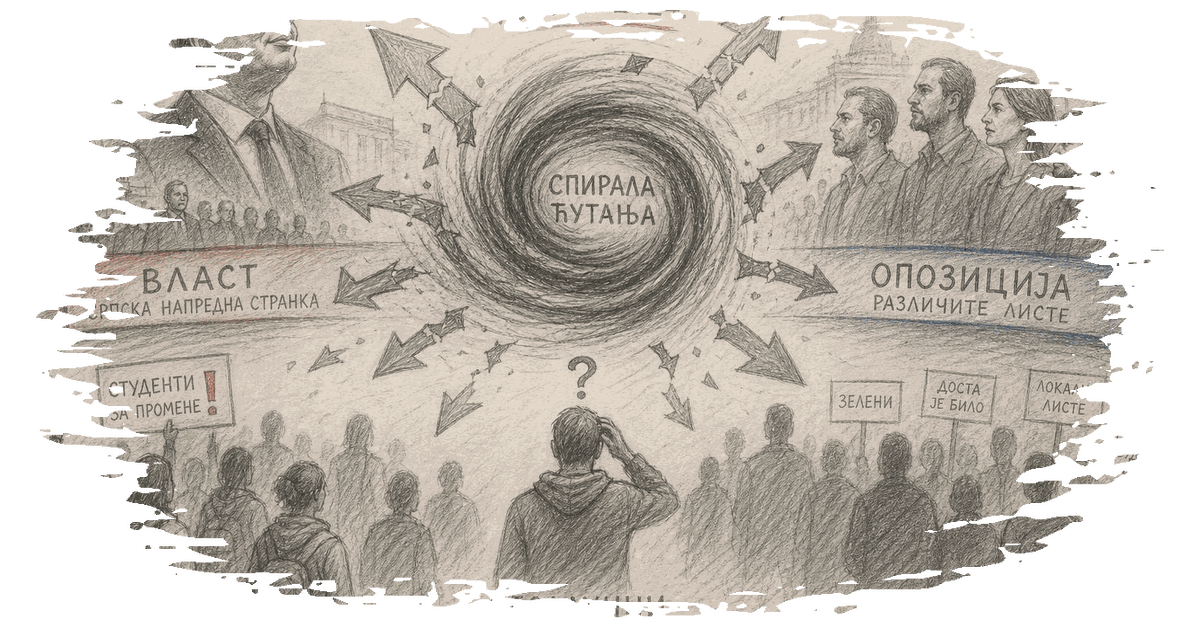
As Serbia approaches its parliamentary elections on October 25, 2026, the political landscape is marked by a significant number of undecided voters, a factor that could play a crucial role in determining the outcome. Political consultant Dušan Lj. Milenković, who specializes in public opinion research, highlights the presence of these undecided voters, noting that many are still deliberating on whether to participate in the elections and whom to support. According to Milenković, while a substantial portion of the electorate has already decided their vote, a key segment remains uncertain, particularly in a polarized environment where the choice is not just between the ruling Serbian Progressive Party (SNS) and the opposition, but also whether to vote at all.
The student movement, which has gained momentum following a series of protests, has maintained a steady level of support. Various polls have shown differing levels of backing for the Students’ List compared to the SNS. For instance, the organization Crta reported a ten percent lead for the Students’ List during the summer, while Nova srpska politička misao indicated a two percent advantage. Conversely, Faktor plus suggested that the SNS holds a significant lead, with a 16 percent margin over the student movement. These discrepancies highlight the complexities of the political climate and the challenges in gauging true voter sentiment.
A non-representative survey conducted by the newsletter Međuvreme revealed that 57 percent of respondents believe the primary focus should be on ensuring fair election control. Meanwhile, 30 percent indicated they have already decided whom to vote for, with only eight percent suggesting that the ongoing campaign might sway some voters. Milenković supports the view that a small portion of the electorate makes their decision close to the election date, emphasizing the importance of these last-minute decisions in a tightly contested race.
The concept of the “spiral of silence,” introduced by German public opinion researcher Elisabeth Noelle-Neumann, is relevant in this context. This theory suggests that as one side of a debate appears stronger in public discourse, more people from that side speak out, attracting additional supporters. In Serbia, this phenomenon is complicated by the existence of two parallel realities, where media narratives can significantly influence public perception. Those who consume pro-government media might view the student movement as traitorous, while others see it as a legitimate challenge to the current regime.
The role of undecided voters is further complicated by the presence of smaller political lists, which struggle to attract support in a polarized environment. According to Milenković, if the anti-regime camp were to mathematically distribute votes such that all opposition blocs surpass the electoral threshold, they could potentially triumph over the ruling party without needing to capture the undecided voters.
The upcoming elections are set against a backdrop of significant student-led protests that have shaped the political discourse in Serbia. The Students’ List, emerging from these protests, represents a new political force challenging the entrenched power of the SNS and President Aleksandar Vučić. The elections will determine the composition of the 250-member parliament, with each list required to gather 10,000 signatures to qualify for candidacy.
As the election date approaches, the dynamics between the student movement and traditional political parties, along with the influence of undecided voters, will be critical in shaping Serbia’s political future. The outcome could have significant implications for the country’s governance and its path toward European integration.



0 Comments