

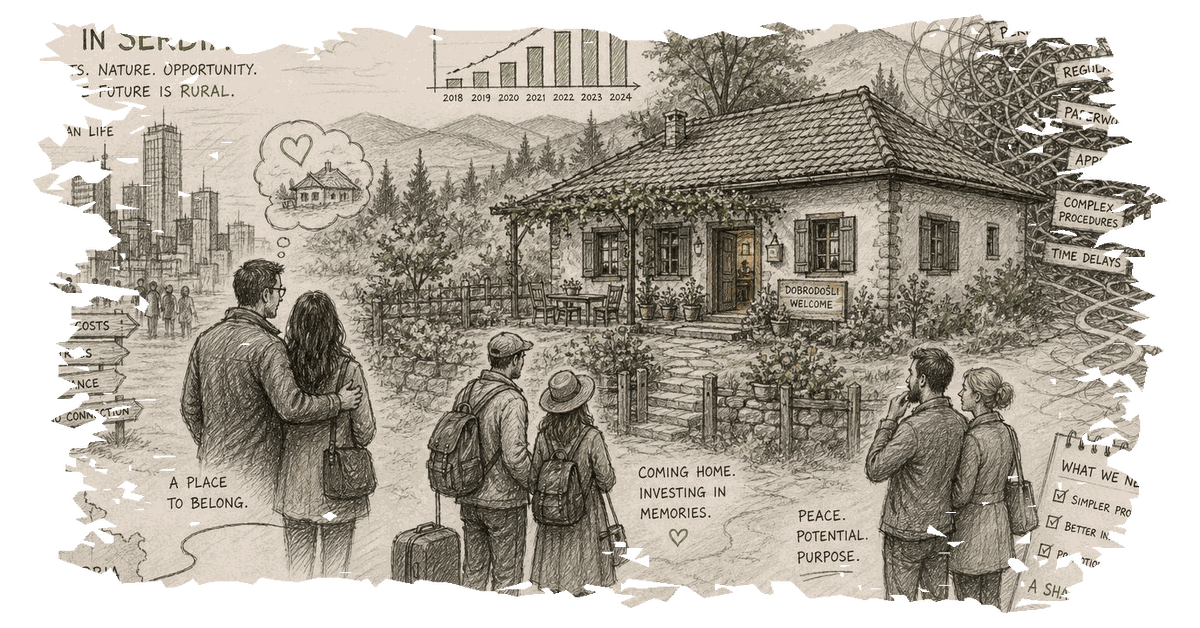
Rural tourism investments in Serbia are gaining traction as buyers are drawn to the affordability of rural properties compared to urban apartments. Properties in rural areas are being sold at prices starting from 20,000 euros, significantly lower than the cost of urban apartments, which has spurred interest among various buyer demographics, including diaspora returnees, urban couples, and small investors. This trend is supported by government incentives aimed at promoting rural tourism, although accessing these funds can be challenging due to bureaucratic hurdles.
The Serbian real estate market is seeing an increase in listings for rural properties, including traditional village households and ethno complexes. Prices for these properties vary widely, ranging from around 20,000 euros for properties requiring significant renovation to over a million euros for large hospitality complexes. For instance, an ethno complex near Aleksandrovac, featuring its own lake, is on sale for 180,000 euros, a price at which one can barely purchase a 50-square-meter apartment in Belgrade.
The demand for rural tourism properties is particularly high in areas like Fruška Gora and along the Danube, where buyers see potential for tourism development. However, the supply is more abundant in regions with lower demand, such as Banat and southern Serbia. This discrepancy between supply and demand highlights the challenges buyers face in finding suitable properties for rural tourism ventures.
Real estate agents Sanja and Vladimir Rafajlović from “Real House” note that the market for ethno houses, apartments, and restaurants is primarily about selling a business rather than just real estate. They mention that the emotional value sellers attach to these properties can complicate pricing and prolong sales. The agents also point out that Serbia has around 1,600 registered rural tourism households, a relatively small number for a country of its size, indicating room for growth in this sector.
The Ministry of Tourism and Youth, along with regional authorities, offers incentives to boost rural tourism, although the process to access these funds is often lengthy and paperwork-intensive. Despite these challenges, the incentives are a significant factor driving interest in rural tourism investments.
Investors are also drawn to the potential for creating unique tourism experiences. For example, Nenad Luković, who owns the “Dedovina na Rzavu 1952” accommodation, has developed a modern facility on his ancestral land in Kruščica, near Arilje. Luković emphasizes the importance of offering a luxurious rural retreat, noting that guests increasingly seek comfort and privacy. He points out that successful rural tourism ventures require constant investment and a commitment to high-quality service.
However, potential investors face challenges such as finding reliable labor and dealing with seasonal fluctuations in tourism demand. The labor market in rural areas is limited, making it difficult to find staff for hospitality roles. Additionally, the tourism season does not last year-round, which can affect profitability.
Overall, the shift towards rural tourism in Serbia reflects broader trends seen across Europe, where rural properties offer a more affordable alternative to urban real estate. This trend is reshaping buyer demographics and market dynamics, with significant implications for the future of Serbia’s tourism and real estate sectors.




0 Comments