

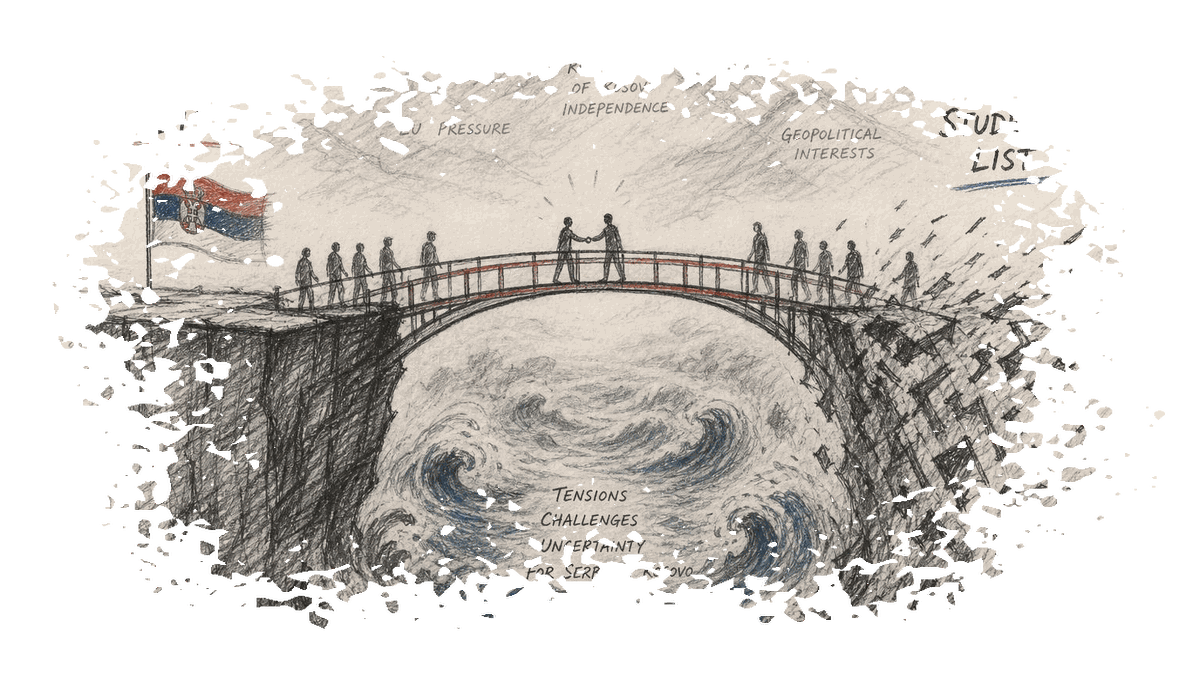
Milovan Drecun, a prominent Serbian politician, has emphasized the critical importance of maintaining the connection between the Serbian List and the Belgrade government for the survival of Serbs in Kosovo. Drecun, who previously chaired the parliamentary Committee on Defense and Security, expressed concerns over the Students’ List’s plans to create a “parallel structure,” which he believes could jeopardize communication with the Serbian community in Kosovo.
Drecun’s comments come amid ongoing political tensions in the region, where the Serbian List is recognized as the legitimate representative of Serbs within Kosovo’s provisional institutions. He criticized the Students’ List for its stance against collaborating with the Serbian List, warning that such actions could undermine the interests and survival of the Serbian people in Kosovo. “The connection between the Serbian List and the government in Belgrade must exist and must not be broken,” Drecun stated, highlighting the role of the Serbian List in advocating for the community’s interests against policies perceived as harmful.
The Students’ List, a new political force in Serbia, has been accused by Drecun of attempting to marginalize the Serbian List, a move he claims is supported by Kosovo’s Prime Minister Albin Kurti. Drecun argues that the Serbian List is essential for negotiating and safeguarding the rights of Serbs in Kosovo, particularly in the face of legislative measures proposed by Albanian parties that could threaten their existence.
Drecun also pointed out that representatives from the Serbian List, who live in Kosovo, have a realistic understanding of the situation on the ground. He questioned how the Students’ List plans to address issues affecting the Serbian community without engaging with their legitimate representatives. “You cannot resolve these problems by ignoring the Serbian List and without communication with them,” he asserted.
The political landscape in Kosovo remains complex, with historical tensions between Serbian and Albanian communities over governance and representation. The Serbian List’s relationship with the Belgrade government has been a cornerstone of its strategy to support the Serbian community in Kosovo. Drecun’s remarks underscore the potential risks of a fragmented approach to representation and the importance of unified advocacy for the Serbian population’s interests.
In the broader context, the situation is further complicated by international dynamics, with Drecun noting that both Brussels and Pristina share a goal of pushing Serbia towards recognizing Kosovo’s independence. He reiterated Serbia’s refusal to accept parts of the Franco-German plan for normalizing relations, which included treating Kosovo as a state.
As the political environment evolves, the role of the Serbian List and its connection to Belgrade will likely remain a pivotal factor in the ongoing discourse over Kosovo’s future and the rights of its Serbian community.




0 Comments